How NEUBIE Therapy May Support Nervous System Regulation in Chronic Pain
Chronic pain can be frustrating, especially when symptoms continue even after an injury has healed or when imaging does not fully explain how much pain someone is experiencing.
One reason this can happen is that pain is influenced by more than just the condition of the tissue itself.
Over time, the nervous system can become more sensitive and protective. This does not mean the pain is imaginary. It means the system responsible for detecting and responding to potential threat may begin reacting more strongly than it needs to.[1,2]
For some patients, successful rehabilitation therefore involves more than strengthening the painful area. It may also involve helping the nervous system become less reactive so that movement feels safer and more comfortable.
Pain Is More Than a Tissue Signal
Pain usually begins as a protective response.
If you sprain an ankle or strain a muscle, pain helps encourage you to protect the injured area while it heals. In most cases, that protective response gradually settles as recovery occurs.
With persistent pain, the relationship can become more complicated.
Research has shown that some people with chronic musculoskeletal pain develop changes in how the nervous system processes sensory information. This is sometimes described as central sensitization or nociplastic pain.[1,2]
Symptoms may include:
- Pain that feels more intense than expected
- Increased sensitivity to pressure or touch
- Pain that spreads beyond the original area
- Persistent muscle guarding
- Symptoms that fluctuate significantly from day to day
- Increased symptoms during periods of poor sleep, fatigue, or stress
- Difficulty relaxing around a painful area
Not every person with chronic pain has nervous system sensitization, and pain can still involve ongoing tissue or nerve related factors. The goal is to determine which factors appear most relevant for each individual.
Where the NEUBIE Fits
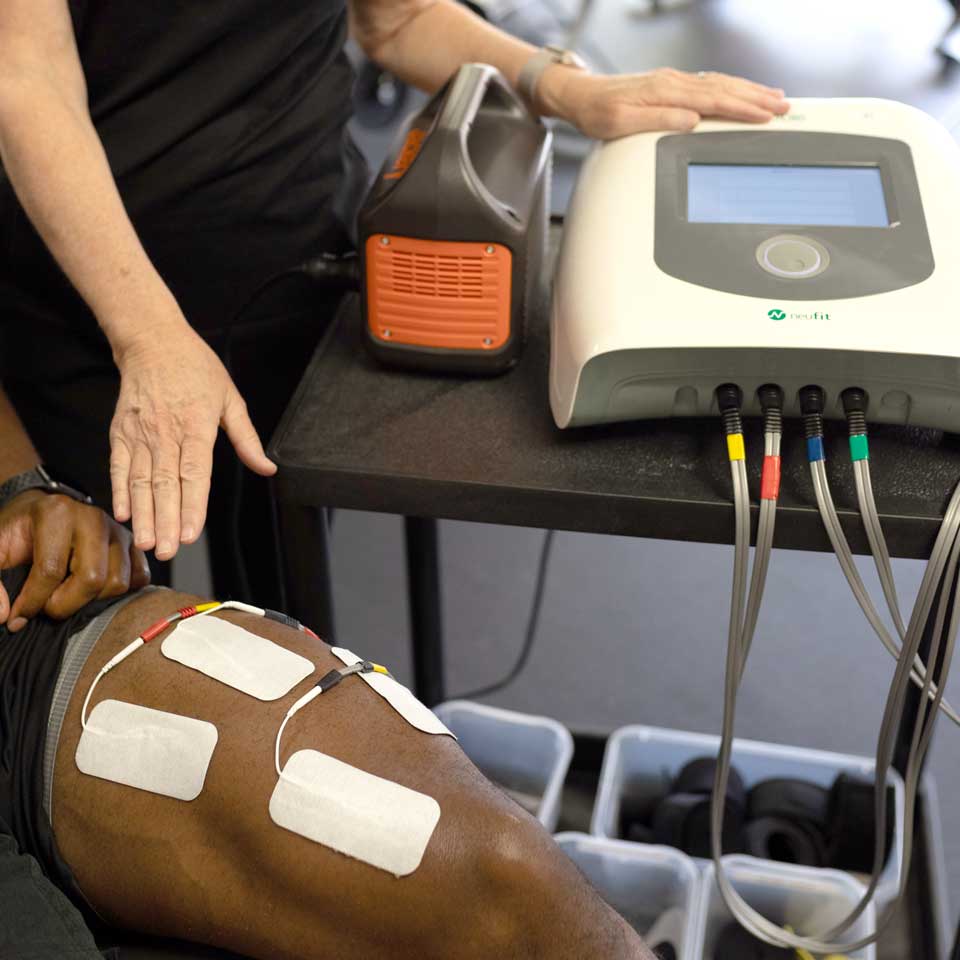
At One on One Physical Therapy, one tool we may use with certain patients is the NEUBIE, or Neuro-Bio-Electric stimulation device.
The NEUBIE uses direct current electrical stimulation and can be applied in different ways depending on the treatment goal.
Rather than thinking of it as a treatment that simply “turns off pain,” we use it as one tool that may help provide controlled sensory input, reduce guarding, improve movement tolerance, and create a better starting point for active rehabilitation.
Hotspot Treatment
One way we may use the NEUBIE is through hotspot treatment.
During a hotspot scan, electrical stimulation is applied while we assess how different areas respond. Some regions may produce a stronger, more uncomfortable, or simply different sensory response.
This does not diagnose the source of pain by itself.
Instead, hotspot findings can be combined with the physical examination, symptom behavior, strength, mobility, and movement testing to help guide treatment.
Once an area is identified, the NEUBIE may be paired with movement, mobility work, or muscle activation. The goal is to change the sensory experience of movement and help the patient tolerate activity more comfortably.
What Is the Master Reset?
Another way we may use the NEUBIE is through the Master Reset.
The goal of a Master Reset session is different from using electrical stimulation primarily for strengthening or muscle activation.
Instead, the session may focus more on relaxation and nervous system regulation.
A Master Reset may be paired with:
- Timed breathing
- Longer, slower exhales
- Progressive relaxation
- Guided awareness of muscle tension
- Comfortable positioning
- Gentle movement as tolerated
The goal is to help reduce unnecessary muscle guarding and give the patient an opportunity to experience a calmer, less reactive state before progressing into movement.
Research specifically examining the NEUBIE Master Reset is still limited. A 2025 case report described use of the Master Reset as part of NEUBIE treatment in a patient with amyotrophic lateral sclerosis, but a single case report cannot establish effectiveness for chronic musculoskeletal pain.[4]
For that reason, we view the Master Reset as a clinical tool within a broader rehabilitation plan rather than a standalone solution.
Why Pair NEUBIE With Breathing?
This is where the broader research becomes especially useful.
Slow, controlled breathing has been studied extensively for its effects on autonomic regulation. A large systematic review and meta analysis of 223 studies found that voluntary slow breathing increased measures of heart rate variability associated with parasympathetic activity during breathing, immediately afterward, and following repeated practice.[3]
In practical terms, controlled breathing can influence the part of the nervous system involved in rest, recovery, and regulation.
This gives us a useful clinical rationale for pairing NEUBIE based sensory input with slow breathing and relaxation.
The electrical stimulation provides one form of sensory input.
The breathing strategy provides another way to influence autonomic regulation.
The combination may help some patients become less guarded and more comfortable before progressing into active rehabilitation.
NEUBIE Is a Bridge, Not the Destination
The goal is not to make someone dependent on the NEUBIE.
The goal is to use it when appropriate to create an opportunity for better movement.
If a patient is less guarded, less sensitive, or more comfortable after hotspot treatment or a Master Reset, we can use that window to progress into:
- Mobility
- Strength training
- Walking
- Running
- Lifting
- Balance
- Sport specific activity
- Gradual exposure to movements that have become painful or threatening
Over time, the goal is to build enough strength, confidence, and capacity that the patient relies less on passive or device based treatment.
How We Use the NEUBIE at One on One
At One on One Physical Therapy, NEUBIE treatment is individualized.
Some patients may benefit most from hotspot work combined with movement.
Others may respond better to a Master Reset paired with timed breathing and relaxation.
Others may not need the NEUBIE at all and may primarily benefit from progressive strengthening, mobility, or changes in training load.
The purpose is not to apply the same protocol to every patient.
The goal is to determine whether NEUBIE based treatment can help reduce sensitivity, improve movement tolerance, or create a better starting point for the next stage of rehabilitation.
For patients with persistent pain, significant muscle guarding, or difficulty relaxing, this can sometimes be an important part of the process.
Considering NEUBIE Treatment in Atlanta?
If persistent pain, muscle guarding, or difficulty relaxing is holding back your rehab, we can help you work out whether NEUBIE treatment makes sense for you. Learn more about the NEUBIE at One on One Physical Therapy, or schedule an evaluation.
William Knight, PT, DPT, CSCS is a physical therapist at One on One Physical Therapy in Atlanta.
References
- Nijs J, George SZ, Clauw DJ, et al. Central sensitisation in chronic pain conditions: latest discoveries and their potential for precision medicine. Lancet Rheumatol. 2021;3(5). PMID: 38279393.
- Fitzcharles MA, Cohen SP, Clauw DJ, Littlejohn G, Usui C, Häuser W. Nociplastic pain: towards an understanding of prevalent pain conditions. Lancet. 2021;397(10289):2098-2110. PMID: 34062144.
- Laborde S, Allen MS, Borges U, et al. Effects of voluntary slow breathing on heart rate and heart rate variability: a systematic review and meta-analysis. Neurosci Biobehav Rev. 2022;138:104711. PMID: 35623448.
- Husted C, Tubman G. Case study: the benefits of the Neubie direct current electrical stimulation device for pain, spasticity, and movement in amyotrophic lateral sclerosis. Integr Med (Encinitas). 2025;24(2):25-29. PMID: 40171058.
This article is for general education and is not medical advice. Please discuss new or worsening symptoms with your healthcare team.