Do You Need a Running Gait Analysis? What It Can and Can’t Tell Us
If you are a runner dealing with pain, recurring injuries, or difficulty increasing mileage, you may have wondered whether your running form is part of the problem.
A running gait analysis can be extremely useful, but only when it is interpreted in context.
At One on One Physical Therapy, we do not look at a running video and try to make every runner move the same way. Instead, we use gait analysis as one piece of a larger assessment that includes your symptoms, strength, mobility, training history, previous injuries, footwear, and goals.
The goal is not to create a “perfect” running form. It is to determine whether anything about the way you run is meaningfully contributing to your symptoms and whether changing it would actually help.
What Is a Running Gait Analysis?
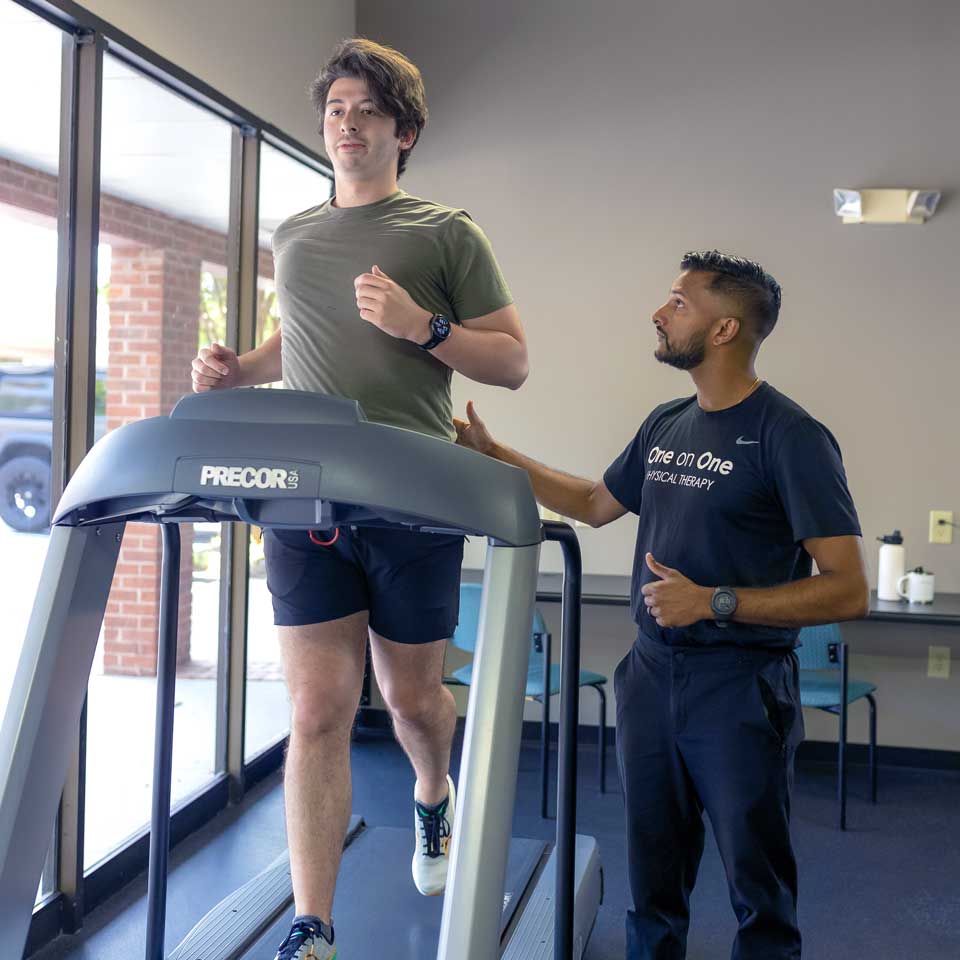
A running gait analysis typically involves recording a runner from multiple angles while running on a treadmill or overground.
Depending on the situation, we may look at factors such as:
- Cadence, or steps per minute
- Stride length
- Where the foot contacts the ground
- Trunk position
- Hip and knee movement
- Pelvic control
- Symmetry between sides
- How the leg absorbs and transfers force
These observations can help us identify patterns that may change where and how much load is placed on different tissues.
For example, research has shown that increasing running cadence by a modest amount can reduce selected loading variables at the knee, hip, and tibia.[1,2]
But that does not mean every runner needs a higher cadence.
There Is No Single “Perfect” Running Form
Running mechanics vary considerably between people.
One of the most common examples is foot strike. Runners are often told they should land on their forefoot instead of their heel to reduce their risk of injury.
The research does not support such a simple conclusion.
A systematic review evaluating foot strike pattern and running injuries found only low quality evidence for an association between how the foot lands and injury risk.[3] Another review found that changing from a rearfoot strike to a forefoot or midfoot strike can reduce some loads at the knee, while simultaneously increasing demands on the ankle and calf.[4]
In other words, changing running mechanics does not simply remove load. It often moves that load somewhere else.
For a runner with knee pain, that shift may occasionally be useful.
For a runner with Achilles or calf symptoms, it might be exactly the wrong change.
That is why gait changes should be based on the individual runner rather than a universal rule about how everyone “should” run.
When Can Gait Retraining Help?
There are situations where intentionally changing running mechanics can be useful.
Patellofemoral pain, commonly called runner’s knee, is one of the most studied examples.
Research suggests that gait retraining strategies such as a modest increase in cadence or learning to land more softly can reduce certain loading variables and improve pain and function in some runners with patellofemoral pain.[1,5]
A systematic review of gait retraining found moderate certainty evidence that cadence focused retraining can increase step rate and reduce vertical loading rate.[1]
More recent review level evidence also suggests that cadence changes of approximately 5 to 10% and softer landing strategies may help selected runners with patellofemoral pain, particularly when retraining is performed progressively rather than through a single instruction.[5]
The key word is selected. A gait change should have a reason behind it.
What a Running Video Cannot Tell Us
This is where gait analysis by itself becomes limited.
A video may show that a runner’s knee moves inward during stance, that their stride appears long, or that one side looks different from the other.
But the video does not tell us why.
It cannot tell us whether that runner has:
- Calf weakness
- Reduced quadriceps strength
- Limited ankle or hip mobility
- A recent spike in training
- Poor recovery
- A history of previous injury
- Reduced tolerance to running volume
- Pain from a tissue that has simply been overloaded
Running injuries are rarely explained by one biomechanical variable.
Research examining running related injury risk shows that injury is multifactorial, with training characteristics, previous injury, health factors, and biomechanics all potentially contributing.[6]
Even research on training load itself is not as simple as commonly repeated rules might suggest. Systematic reviews have found inconsistent relationships between specific mileage, frequency, or intensity thresholds and injury across runners.[7]
This is why the examination surrounding the gait analysis matters as much as the video itself.
How We Evaluate Runners at One on One
At One on One Physical Therapy, the running analysis is only one part of the evaluation.
For example if you come to us with knee pain while running we may examine:
- Your running mechanics
- Quadriceps and hip strength
- Calf strength and endurance
- Ankle and hip mobility
- Single leg control
- Your recent mileage and training changes
- Previous injuries
- The types of runs that provoke symptoms
- Footwear
- Your current training and racing goals
We then compare what we see in the clinic with what we see while you run.
Sometimes gait retraining becomes an important part of treatment.
Sometimes the running form is perfectly reasonable and the bigger issue is strength or tissue capacity.
Sometimes we simply need to modify training temporarily while rebuilding the body’s ability to tolerate the demands of running.
The value of gait analysis is not in finding something that looks “wrong.” It is in determining which findings actually matter for the runner in front of us.
Do You Need to Change Your Cadence?
Cadence receives a lot of attention in running discussions.
There is good evidence that increasing cadence can change running mechanics and reduce certain loading variables.[1,2] But there is no universal cadence every runner needs to achieve.
Rather than trying to reach an arbitrary number such as 180 steps per minute, we may occasionally increase a runner’s natural cadence by a small amount when there is a specific reason to do so.
For example, a modest increase may shorten stride length and reduce patellofemoral joint loading in a runner with knee pain.[2]
That does not mean higher cadence is automatically better.
The question remains:
Does changing cadence improve the specific problem we are trying to solve?
Who Might Benefit From a Running Gait Analysis?
A running assessment may be particularly useful if you:
- Have pain that primarily occurs while running
- Have experienced recurring running injuries
- Keep developing symptoms when increasing mileage
- Are returning to running after an injury or surgery
- Feel noticeably different between your right and left sides
- Have been told that your running form is causing your injury
- Want to understand whether your mechanics should actually be changed
It can also be useful for runners who simply want a better understanding of how their strength, mobility, and running mechanics interact.
The Goal Is Not to Make Every Runner Look the Same
The human body is adaptable, and there are many ways to run successfully.
At One on One Physical Therapy, we use gait analysis to understand how your running mechanics interact with your strength, mobility, tissue capacity, training demands, and symptoms.
Video gives us valuable information, but it does not tell the entire story.
By combining your running analysis with a detailed orthopedic examination and training history, we can determine which findings matter, which do not, and whether changing your running mechanics should actually be part of your plan.
The goal is not to create perfect running form. It is to help you run with greater capacity, confidence, and fewer limitations.
Considering a Running Gait Analysis in Atlanta?
If running pain keeps coming back, or you are building mileage after an injury, we can look at how you run alongside your strength, mobility, and training history. Learn more about running analysis at One on One Physical Therapy, or schedule an evaluation.
William Knight, PT, DPT, CSCS is a physical therapist at One on One Physical Therapy in Atlanta.
References
- Doyle E, Doyle TLA, Bonacci J, Fuller JT. The effectiveness of gait retraining on running kinematics, kinetics, performance, pain, and injury in distance runners: a systematic review with meta-analysis. J Orthop Sports Phys Ther. 2022. PMID: 35128941.
- Figueiredo I, et al. The influence of running cadence on biomechanics and injury prevention: a systematic review. 2025. PMID: 40964543.
- Anderson LM, Bonanno DR, Hart HF, Barton CJ. What are the benefits and risks associated with changing foot strike pattern during running? A systematic review and meta-analysis of injury, running economy, and biomechanics. Sports Med. 2020. PMID: 31823338.
- Hamill J, Gruber AH. Is changing footstrike pattern beneficial to runners? Findings regarding running injury risk remain limited. See also: Burke A, et al. Risk factors for injuries in runners: a systematic review of foot strike technique and its classification at impact. 2021. PMID: 34527750.
- Petri AC, et al. Gait retraining for patellofemoral pain in runners: an umbrella review of clinical and biomechanical evidence. 2026. PMID: 42295581.
- Risk factors for running related injuries: an umbrella systematic review. 2024. PMID: 38697289.
- Fredette A, et al. The association between running injuries and training parameters: a systematic review. J Athl Train. 2022. PMID: 34478518.
This article is for general education and is not medical advice. Please discuss new or worsening symptoms with your healthcare team.